
Pebble Index 01 Review: 24 Hours In (October 2026)
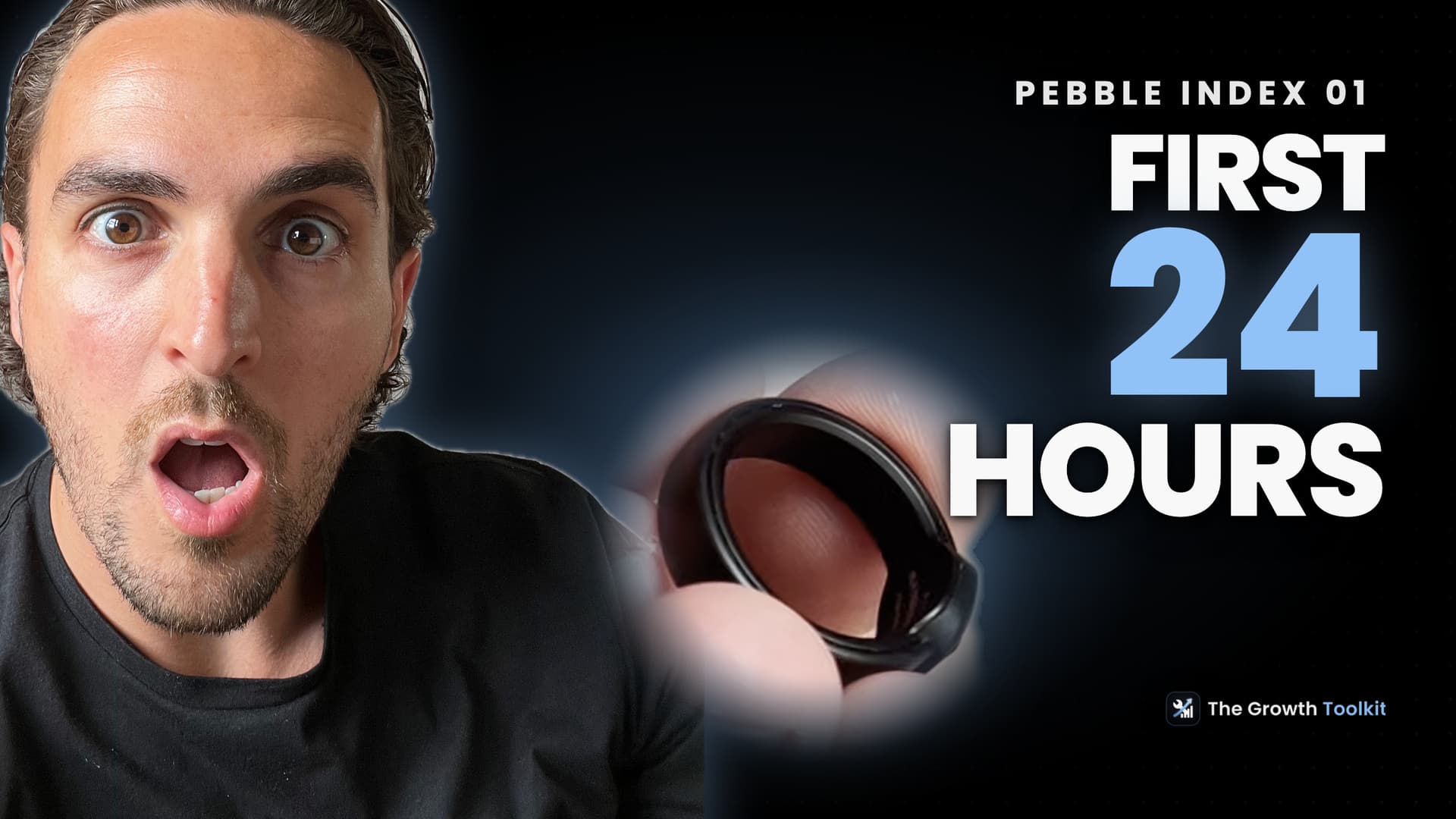
I pre-ordered the Pebble Index 01 in January. Pebble said March. It landed on my doormat on 19 August, five months late.
This is my honest review after wearing it for 24 hours. Not a rewrite of the press release, which is most of what is out there at the moment, because pre-orders only went into mass production at the end of July and there are still over 13,000 of them working through the queue.
Short version: I am keeping it, and the reason is not the one I expected.
What the Pebble Index 01 is
It is a ring. Stainless steel with a plastic outer, about the size of a wedding band, with one rubber button and one microphone in it. No screen. No sensors. It tracks nothing.
You hold the button, talk into it from about five to ten centimetres away, and let go. The recording goes over to your phone, gets turned into text on the phone itself rather than in the cloud, and then gets filed as a note, a reminder, a shopping list, or wherever else you have pointed it.
Two details make it interesting. First, you never charge it: there is a small silver-oxide cell in there, the sort that goes in a hearing aid, and Pebble reckon that lasts around two years. Second, it only listens while your finger is physically on the button. There is no wake word and nothing is running in the background. That second point is the only reason I was willing to wear a microphone on my hand all day.
There is no subscription, and the transcription works offline. It is the same Pebble as the smartwatches, now trading as Core Devices.
What it cost me, all in
I paid £75 for the ring plus about £10 shipping, so £85 all in. The £75 was the pre-order price, and it has gone up since.
That £10 of shipping is not in any of the headline figures you will see, so factor it in if you are budgeting from the coverage rather than the checkout.
The moment it earned its money
I captured about ten notes in the first 24 hours. Setup took under five minutes, from sealed box to a working note.
The first was a shopping list, purely to test it, using a list that was already sitting in the app. It worked perfectly first go. Then I was half asleep in bed and remembered a call I needed to make, so I pressed it and said it, without turning a light on or picking my phone up.
Then the one that sold it to me. I was out on a run and a business idea landed.
Normally that idea has two futures. Either I stop, dig my phone out of my waist pack, unlock it, find Todoist, and break my run. Or I promise myself I will remember it, and I do not. This time I pressed the ring, said it, and kept running. Ten seconds. That was the exact reason I bought it, so it was satisfying to have it work on day one.
The bit I did not expect
Here is the thing I got wrong before it arrived.
I already had this solved, or thought I did. I use Wispr Flow for dictation on my phone and MacBook, and Granola for meeting notes. On paper I did not need another way to capture a thought.
But all of that lives on a device, and the device is the problem. Every time I pick my phone up to save one idea, I am also picking up my work email, my WhatsApp and everything else waiting for me. Ten seconds of capture turns into ten minutes of being pulled back into work.
So the real win is not that the ring is faster. It is that I can get the thought out of my head and stay switched off. If I am out socialising, exercising or up a hill somewhere, I can stay present and still not lose the idea. That is a rest thing rather than a productivity thing, and I did not see it coming.
Four honest problems
Pebble told buyers, in writing, that the software "will undoubtedly have bugs and rough edges for months, if not years". They were not managing expectations for the sake of it. Here is what I hit in one day.
1. The sizing. Pebble say it comes up small. Every early owner said the same. So I got measured properly in a jewellery shop and sized up from a nine to a ten. It was still too tight on the index finger I had planned to wear it on, so I wear it on my middle finger instead, which is fine but not what I ordered for. They do a sizing kit you can order or 3D print, and I was too impatient to bother. Do not be me, because Pebble do not offer exchanges.
2. The app. It is fine. It is not beautiful and it is not the most intuitive thing I have used, but it is a small startup, so I will give them that. The real gap is that there is no desktop app and no browser login. My ideas are stuck on my phone, which defeats part of the point. I would use a web version the day they shipped one, if only to copy things out into Todoist without picking the phone up again.
3. Water. It is rated to one metre and showering is allowed. But I used it coming out of the shower and it did not register what I said. I had to blow the water out of the microphone, and it was fine after that. Worth knowing rather than a dealbreaker.
4. Confidence, and this is the one that bugs me. There is a small green light that flashes when a capture saves. You cannot see a green flashing light outdoors in daylight, which is exactly where I was using it. So I spent the day about 85 to 90 percent sure my thoughts were in there. For a device whose entire job is that you never lose a thought, 90 percent is not quite there yet.
The cost nobody is mentioning
Here is the part I have not seen anyone else make properly.
You cannot recharge it. When the battery goes in about two years, the device is done. Pebble's own plan is that the app prompts you to order a replacement ring and recycle the old one.
So spread £85 across a two-year battery and you are at roughly £3.50 a month.
That is fine. I am not complaining about £3.50 a month for something I use every day. But let us call it what it is. That is not a one-off purchase, it is a subscription you have paid up front. Nobody markets it that way, and if you are the sort of person who scrutinises recurring costs, you should put this in that column rather than the hardware column.
Would I pre-order from Pebble again?
Probably, but I would expect it late.
I did wonder for a while whether they had hit real problems or were quietly assessing demand. The answer is more boring than that: they only got into mass production at the end of July, against a queue of more than 13,000 pre-orders. So it was not personal, and it was not just me. They posted updates publicly the whole way through, which is more than a lot of hardware startups manage.
If you are ordering now rather than pre-ordering, none of this applies to you. You are buying a product that exists.
Who should buy it, and who should not
Buy it if your best ideas turn up when your hands are busy. Driving, showering, running, walking the dog, mid-conversation. If the friction of getting your phone out is the reason you lose ideas, this removes that friction completely. It is also a genuinely good answer if you are trying to be less on your phone rather than more.
Do not buy it if you want health tracking, in which case buy an Oura instead. Do not buy it if you want polished software from day one. And do not buy it if you are already happy pulling your phone out, because then you are paying £85 to solve a problem you do not have.
For more of the tooling I run the business on, I keep a running list of the AI tools I use as a UK business owner.
Verdict after 24 hours
I am keeping it.
It does the one thing it said it would do, and the thought it caught on that run was worth the money on its own. The hardware is better than the software, which is exactly what Pebble told everyone to expect, and the honest 24-hour score is that the concept is right and the polish is not there yet.
I will publish a 30-day follow-up here once I know whether I am still wearing it or whether it has ended up in a drawer. That is the review that will really tell you something, and the one I would want to read.
You can see the ring on Pebble's product page. That is not an affiliate or referral link, and this is not a sponsored review. I paid £75 plus £10 shipping like everyone else.
More honest reviews
- Desktronic HomePro review, four months in - the standing desk I write all of this from
- Wayfront review - the client portal software we run at the agency
- Wispr Flow referral code and review - the dictation tool the ring is competing with on my own desk
- Best AI tools for UK entrepreneurs in 2026 - the full stack
- Best standing desk UK - if you are building out a home office
Mike McDonnell. I write The Growth Toolkit, a free Sunday email on getting the most out of AI, with the setups I use explained in plain English.

Mike McDonnell
Entrepreneur, author, and mental health advocate based in Great Notley, Braintree, Essex. I write about building businesses while managing bipolar disorder.
You might also like
Lovable Promo Code and Discounts: What Works (October 2026)
Looking for a Lovable promo code? There is no public code. Here are the discounts that work in October 2026, from 50% off for students to free credits.
Lovable Review: Pricing, Credits and Who It Suits (October 2026)
An honest Lovable review from someone who has built live tools with it. UK pricing, how credits work, the free plan, GitHub and who should pick something else.
Lovable vs Claude Code: Why I Switched (October 2026)
Lovable vs Claude Code from someone who used Lovable, moved to Cursor and now builds everything in Claude Code. Cost, control, and which to pick for what.