
AJ Bell Review UK 2026: Honest Verdict After 7 Years as an Agency Founder
Link checked
Ad/affiliate disclosure: this post contains affiliate links. If you sign up through one I may receive a referral payment, at no extra cost to you and with no reduction to any bonus. I only recommend products I have used myself.
- Trustpilot4.8/5(4,000)
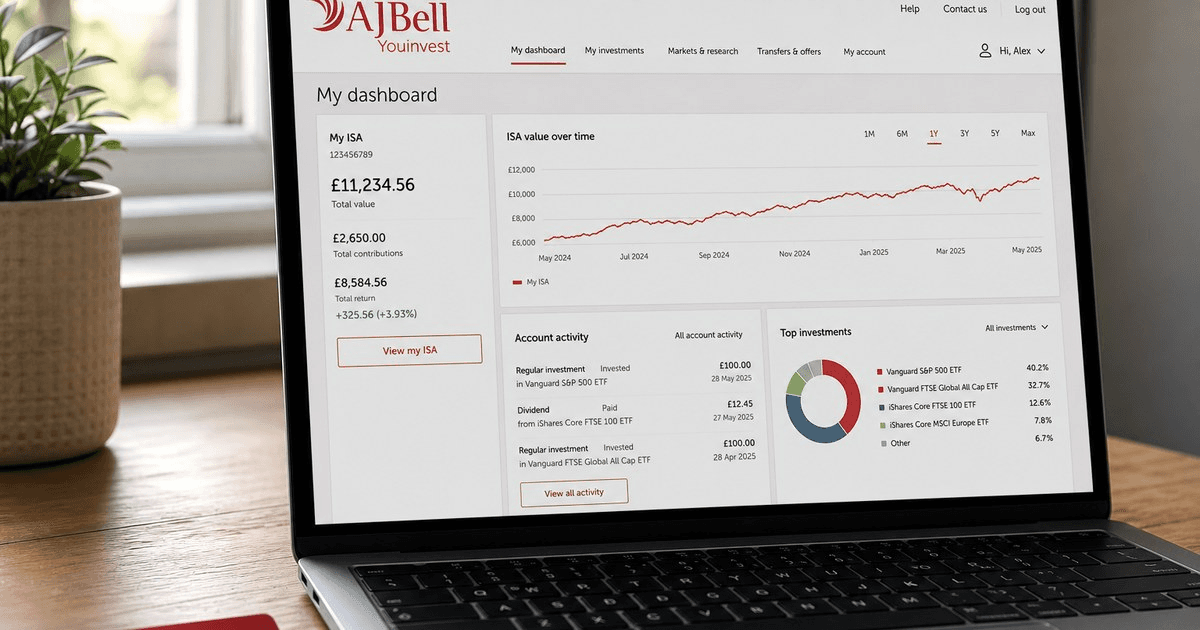
Looking for an honest AJ Bell review from someone with money on the platform? I have held my AJ Bell Stocks and shares ISA for around six to seven years. My money has been on there through market downturns, rate rises, and the occasional moment when I have called to ask a human a question.
The short verdict: AJ Bell is a solid, well-regulated investment platform. It is not the cheapest option on the market, but the phone support is genuinely the best I have used anywhere, the app is clean and reliable, and you can hold a full range of UK and overseas shares alongside funds in the same account. For most UK investors who want more than a passive ETF tracker, it is a strong choice.
If you are opening a new account, use my referral link and you both get a £100 Amazon.co.uk gift card when you fund £10,000 within 120 days:
👉 Open an AJ Bell account with the £100 referral offer
The value of investments can go down as well as up. You may get back less than you put in. This post is not financial advice.
What Is AJ Bell?
AJ Bell is one of the UK's largest independent investment platforms. It has been running since 1995, listed on the FTSE 250 in 2018, and now looks after billions of pounds for hundreds of thousands of UK investors.
In practical terms, it is a place to hold and grow your money through different account types:
- Stocks and shares ISA for tax-free investing up to your annual allowance (£20,000 for the 2026/27 tax year)
- SIPP (Self-Invested Personal Pension) for retirement saving with tax relief on contributions
- Lifetime ISA for first-home buyers and retirement saving, with a 25% government bonus on up to £4,000 a year
- Dealing account for investing outside a tax wrapper
- Junior ISA and Junior SIPP for children
AJ Bell is a long-established, FCA-regulated business. That matters when you are parking decades of savings somewhere.
AJ Bell Fees Explained
Fees are where a lot of reviews go vague. Let me be specific. Every figure below was checked against AJ Bell's own Stocks and shares ISA charges page on 4 September 2026. Check it yourself before investing, since charges change.
| Charge | AJ Bell (ISA) | Notes |
|---|---|---|
| Account charge on funds | 0.25% per year on the first £250,000 | Then 0.10% from £250,000 to £500,000, and nothing at all above £500,000 |
| Account charge on shares, trusts, ETFs, gilts | 0.25% per year | Capped at £3.50 a month inside an ISA |
| Share deals | £5.00 per deal | Drops to £3.50 if you made 10 or more share deals the previous month |
| Fund deals | £1.50 per deal | Online or via app |
| Regular investing (monthly) | Free | From £25 a month into selected investments |
| Account opening | Free | |
| ISA transfer in | Free | AJ Bell also covers your old provider's exit fees up to £500 if the account is worth £20,000 or more |
| Withdrawals | Free | |
| Holding cash | Free | |
| FX on international shares | Capped at 0.75% | Charged on top of the dealing fee |
Correction worth flagging, because this page had it wrong until 4 September 2026. The funds account charge is not a flat uncapped 0.25%. It tiers down: 0.25% to £250,000, then 0.10% to £500,000, then nothing above that. On a £600,000 fund portfolio that is the difference between £1,500 a year and £875. Anyone who read the old version and assumed the charge scaled forever was reading a worse deal than AJ Bell offers.
The cap on shares is the most useful number for most investors. If you hold £20,000 in individual shares inside an ISA, you pay a maximum of £42 per year in platform charges regardless of how the holding grows. That is competitive against many rivals.
The May 2026 fee change is worth knowing about. AJ Bell previously charged £1.50 per regular-investing trade. That charge was removed in May 2026, making scheduled monthly purchases free, and it is still free as of 4 September 2026. The minimum is £25 a month into selected investments. If you drip-feed money into the same funds every month, this is a genuine saving.
The frequent dealer charge is a discount, not a penalty, and it is easy to read the wrong way round on AJ Bell's own page. If you placed 10 or more share deals last month, this month's share deals cost £3.50 instead of £5.00. It rewards activity rather than punishing it, which is unusual, and it matters if you trade individual shares regularly.
Where AJ Bell is not the cheapest: if you only want a simple ETF portfolio and will never buy individual shares, free platforms like InvestEngine or Trading 212 undercut it on headline cost. The trade-off is that you give up phone support and the broader investment range.
Which AJ Bell Account: ISA, SIPP, Lifetime ISA or Junior ISA?
Most "AJ Bell review" searches are really about one specific account, so here is each of them side by side. Be clear on what I can and cannot tell you first-hand: I hold the Stocks and shares ISA and nothing else. The SIPP, Lifetime ISA and Junior ISA sections below are read from AJ Bell's published charges, not from my own money, and I say so in each one rather than implying an experience I do not have.
All four charge figures were checked on AJ Bell's own per-account charges pages on 4 September 2026.
| Shares account charge | Funds account charge | Share deal | Fund deal | |
|---|---|---|---|---|
| Stocks & shares ISA | 0.25%, capped £3.50/mo | 0.25% to £250k, 0.10% to £500k, free above | £5.00 | £1.50 |
| SIPP | 0.25%, capped £10/mo | 0.25% to £250k, 0.10% to £500k, free above | £5.00 | £1.50 |
| Lifetime ISA | 0.25%, capped £3.50/mo | 0.25%, no tiering published | £5.00 | £1.50 |
| Junior ISA | 0.25%, capped £2.50/mo | 0.25%, no tiering published | £5.00 | £1.50 |
Regular investing is free on all four from £25 a month. The frequent-dealer rate of £3.50 a share deal applies across all of them if you placed 10 or more share deals the previous month.
AJ Bell Stocks and Shares ISA review
This is the one I hold, and have for six to seven years. Everything in the how I use it section below is about this account specifically.
The short version: it is a good ISA rather than the cheapest ISA, and the £3.50 monthly cap on shares is the number that decides it. If you hold individual shares, investment trusts or ETFs, your account charge stops at £42 a year however large the holding grows. That is a genuinely strong deal at size and it is the reason I have never moved.
If you hold funds only, the cap does not apply and you pay 0.25% up to £250,000. At that point the free apps undercut AJ Bell and I would not pretend otherwise. My own account is a low-cost tracker as the core with a few individual shares alongside, which is exactly the mixed shape the charging structure suits.
AJ Bell SIPP review
I do not hold an AJ Bell SIPP, so treat this as a reading of the published terms rather than a review of the experience.
The pricing follows the same shape as the ISA with one important difference: the cap on shares, trusts and ETFs is £10 a month rather than £3.50, so £120 a year instead of £42. The funds charge tiers identically, 0.25% to £250,000, 0.10% to £500,000 and nothing above. Dealing is the same at £5.00 and £1.50.
That higher cap is worth doing the maths on, because pension pots tend to be larger than ISAs. On a £200,000 share-heavy SIPP you pay £120 a year, which is still cheap in absolute terms. On a £200,000 fund-heavy SIPP you pay £500. The gap between those two is far bigger than most platform comparisons make clear, and it is a function of what you hold rather than which provider you picked.
AJ Bell Lifetime ISA review
I do not hold a Lifetime ISA. Again, published terms only.
AJ Bell charges the same 0.25% on shares with the same £3.50 monthly cap as the main ISA, so a share-based LISA costs at most £42 a year. The funds charge is a flat 0.25% with no tiering published, which makes sense given the £4,000 annual contribution limit means these accounts rarely reach the £250,000 where tiering would start.
The thing that decides a Lifetime ISA is almost never the platform charge, it is the government rules: the 25% bonus, the age limits on opening and contributing, and the withdrawal penalty if you take money out for anything other than a first home or retirement. Those are HMRC rules that apply identically wherever you hold it, so read gov.uk on Lifetime ISAs before you pick a provider. AJ Bell is a reasonable home for one. It is not the reason to open one.
AJ Bell Junior ISA review
I do not hold a Junior ISA either.
The charge structure is the friendliest of the four: 0.25% on shares capped at £2.50 a month, so £30 a year maximum, with funds at a flat 0.25%. Dealing is £5.00 and £1.50 as everywhere else, and regular investing from £25 a month is free.
For a JISA that is a sensible fit, because the typical pattern is a modest monthly contribution over many years, and free regular investing plus a low cap is exactly the right shape for that. The one thing to weigh is that a fund-only JISA pays an uncapped 0.25%, so if you are buying a single global tracker every month and nothing else, the cheaper passive-only platforms are worth comparing.
AJ Bell App Review
First-hand, since I use it most weeks.
It is clean and it works. Buying and selling takes a few taps, the portfolio balance loads quickly, and I have never had it crash or show me a wrong number in six to seven years. It is not the slickest app on the market and it is not trying to be; newer apps look better and do less.
My one consistent gripe is the minimum order when you buy by cash amount. Enter a pound figure rather than a number of shares and the app will sometimes reject it without telling you what the minimum is, so you nudge the number up until it goes through. It is small, it has never cost me money, and it is the only part of the app that has irritated me repeatedly.
If you are choosing a platform on app quality alone, AJ Bell is not the winner. If you want an app that is reliable and gets out of the way, it is fine, and the phone support behind it matters more than the interface.
AJ Bell Funds and Passive Investing
Also first-hand. The bulk of my ISA is a low-cost S&P 500 tracker, with a small number of individual shares alongside it.
The reason I hold funds at AJ Bell rather than at a cheaper passive-only platform is that I want both in one account. Vanguard locks you into Vanguard's own range. The free apps have narrower coverage and no phone line. AJ Bell lets the passive core and the individual shares sit under one login, and that convenience is what I pay the 0.25% for.
Be clear-eyed about the cost though. Funds do not get the £3.50 cap, so a fund-only portfolio at AJ Bell costs 0.25% a year up to £250,000 with nothing capping it. On £50,000 of funds that is £125 a year, against £75 at Dodl and less again at the free apps. If your plan is one global tracker and nothing else, you are paying for flexibility you will not use, and one of the cheaper platforms is the better call.
A note on the old name: AJ Bell Youinvest was the previous brand for this platform and it is now just AJ Bell. If you are searching for "AJ Bell Youinvest review" or landed on an old page, it is the same platform under a shorter name, and the charges above are the current ones.
AJ Bell vs Other UK Investment Platforms
AJ Bell vs Hargreaves Lansdown
Hargreaves Lansdown (HL) is the most common comparison. The short answer: AJ Bell is cheaper on funds for most portfolio sizes.
| Portfolio (funds) | AJ Bell annual fee | Hargreaves Lansdown annual fee |
|---|---|---|
| £10,000 | £25 | £45 |
| £25,000 | £62.50 | £112.50 |
| £50,000 | £125 | £225 |
| £100,000 | £250 | Approx. £338 (HL's tiered rates) |
HL has a broader research section, more editorial commentary, and slightly richer market news tools. Both offer real phone support, which the free apps do not. If cost is your deciding factor and you hold mostly funds, AJ Bell wins. If you are a large investor who values HL's Wealth Shortlist and research depth, HL is a fair choice.
Note: HL uses tiered percentage fees that become more complex at higher amounts. Use HL's own fee calculator for precise figures before switching.
AJ Bell vs Vanguard
Vanguard charges 0.15% per year with a cap of £375 per year across your whole portfolio. Dealing costs are lower. The limitation: you can only hold Vanguard's own funds and ETFs. No individual shares, no third-party funds.
For a passive, all-Vanguard global tracker portfolio, Vanguard is hard to beat on price. For anything more varied, AJ Bell is the more flexible choice.
AJ Bell vs Dodl
Dodl is AJ Bell's own simplified app, charging 0.15% a year against full AJ Bell's 0.25%.
This page previously put the crossover at about £28,000 and that was wrong twice over. It compared Dodl's charge on funds against full AJ Bell's capped charge on shares, which are two different fees, and the comparison assumed a choice that does not exist. Dodl does not offer individual share dealing at all.
So there is no crossover to calculate. The two questions are simpler than that:
- Do you want individual shares? Then Dodl is not an option and the comparison ends there. Full AJ Bell, where the account charge on shares, trusts and ETFs caps at £3.50 a month, so £42 a year however large the holding grows.
- Funds only? Dodl charges 0.15% against full AJ Bell's 0.25%, at every balance rather than above a threshold. On £30,000 that is £45 a year against £75. Dodl is simply cheaper, and the trade is a narrower range and no phone support.
The phone support is the thing I stay for, and it is worth more to me than the 0.10% difference. That is a preference, not a recommendation. Dodl's 0.15% and its investment range are carried over from an earlier check and were not re-verified on 4 September 2026.
The trade-offs with Dodl: no individual share dealing, a curated rather than full fund list, and no phone support. For new investors who want a guided start, it is worth a look. For anyone who wants shares or needs to call a human, full AJ Bell is the right choice.
AJ Bell vs Interactive Investor
Interactive Investor charges a flat monthly subscription rather than a percentage. At lower portfolio sizes (below around £30,000 to £40,000), the flat fee makes it more expensive than AJ Bell. At larger portfolio sizes (above £100,000 or so), the flat fee starts to undercut AJ Bell's percentage charge on funds. If you are building toward a large portfolio, this crossover is worth tracking.
AJ Bell for the Self-Employed and Company Directors
Most reviews skip this angle entirely.
If you run a limited company or work self-employed, the choice between an ISA and a SIPP has extra dimensions beyond the standard advice. A SIPP lets your limited company make employer contributions directly from the company account, which reduces corporation tax (you are paying pension contributions before profit is taxed rather than after). An ISA does not have that advantage, but the money is more accessible before retirement without tax penalties.
Many self-employed people and directors I know use both: the SIPP for long-term retirement money where the full tax-relief benefit applies, and the ISA for medium-term savings they might need in the next ten to fifteen years. AJ Bell supports both in the same dashboard, which is a practical convenience over using two separate providers.
The other self-employed question is whether to invest via the company or personally. Broadly, paying employer contributions from a limited company into a SIPP is one of the most tax-efficient things a director can do with surplus cash. But the detail depends on your salary, dividend strategy, and whether you are close to the annual allowance. This is worth an annual conversation with your accountant, not a one-time decision.
AJ Bell itself does not give you financial advice (it is an execution-only platform), but having both accounts in one place means fewer logins and one phone number when you have questions.
How I Use AJ Bell, and What It Costs Me
I have had my AJ Bell Stocks and shares ISA for around six to seven years, so this is my own money on the platform, not a test account.
What I like:
- The phone support is the best I have encountered on any financial platform, full stop. Any time I call, I get through to a real human in what feels like under 30 seconds. No hold music, no multi-level menu trees, no "we will call you back". For something as important as my ISA, knowing I can reach a person quickly matters far more to me than saving a few basis points. I have tested this at different times of day over years and it has been consistently fast and genuinely helpful
- The app is clean and does what you need it to. Buying and selling takes a few taps. Checking my portfolio balance is quick. I never have to hunt through sub-menus to find basic features. It is not as visually slick as some newer apps, but it is reliable and I have never had it crash or show me incorrect data
- I can hold my passive core and individual shares in the same account. The bulk of my ISA is in a low-cost S&P 500 tracker, with a small number of individual shares alongside it. Both sit in the same login. That is the practical advantage of AJ Bell over Vanguard, which locks you into its own fund range
- Regular investing runs without friction. I set up a monthly amount to buy a fund automatically and it just happens. Since the fee removal in May 2026, scheduled monthly purchases are also free, which was a welcome change for anyone drip-feeding money in
- Withdrawing money has been quick every time. I have taken cash out of my ISA twice over the years. Both times the money was in my bank account within two to three working days. Some platforms make withdrawals surprisingly difficult. AJ Bell has not
What is worth knowing:
- My one genuine gripe is the minimum order when buying by cash amount. If you buy a share by entering a pound figure rather than a number of shares, the app sometimes rejects it without explaining the minimum required. You end up nudging the figure up until the order goes through. It is a small thing, but it is the one part of the app that has irritated me consistently over seven years
- AJ Bell is not the cheapest option if all you want is a passive fund portfolio. The free apps undercut it on headline fees. That trade-off is real, and I would not pretend otherwise. I stay because the phone support and the share dealing justify the cost for how I invest
- The research and market commentary is functional rather than exceptional. HL has a more developed editorial offering. AJ Bell's research tools are adequate but not a reason to choose the platform on their own
- Investing carries real risk. My portfolio has had down years, including a meaningful drawdown in 2022. That is normal for equity markets and I mention it because a review that only shows the upside is not being straight with you
I stayed on AJ Bell through the 2022 drawdown partly because the platform was steady and partly because I could call a human when I had questions. That experience, more than anything else, is why I have kept the account for seven years and why I refer people to it.
Is AJ Bell Safe?
Yes, with the standard investment caveat.
AJ Bell Securities Limited (firm reference number 155593) and AJ Bell Management Limited (firm reference number 211468) are authorised and regulated by the Financial Conduct Authority. You can verify both on the FCA Register. AJ Bell is also a FTSE 250 listed company and has been operating since 1995, which puts it in a different risk category from a recent startup.
Your money and investments are protected up to £85,000 by the Financial Services Compensation Scheme (FSCS) if AJ Bell itself were to fail. Client money is held separately from the company's own money, as FCA rules require.
The critical point: the FSCS covers platform failure, not market losses. If your S&P 500 fund falls 30% in a downturn, that is market risk and no compensation scheme covers it. You may get back less than you invested. That is the nature of equity investing, and a review that does not say it plainly is not being honest.
AJ Bell has a Trustpilot rating of around 4.8 out of 5 from over 4,000 reviews as of August 2026, which matches my own experience of the service.
Frequently Asked Questions
Is AJ Bell good for beginners?
For beginners who want a proper platform with phone support and a full investment range, yes. The app is clean and easy to navigate. If the absolute lowest cost is the priority and you are happy with an app-only experience holding only ETFs, free platforms like InvestEngine or Trading 212 are cheaper. AJ Bell is worth the slight extra cost if phone access and the ability to hold individual shares matter to you.
Is AJ Bell FCA regulated?
Yes. AJ Bell Securities Limited (FRN 155593) and AJ Bell Management Limited (FRN 211468) are both authorised and regulated by the FCA. You can verify both on the FCA Register. AJ Bell is also a FTSE 250 listed company.
How much does AJ Bell charge?
As of August 2026: 0.25% per year on funds, with the charge on shares inside an ISA capped at £3.50 per month. Share deals cost £5, fund deals £1.50. Regular monthly investing is free following the May 2026 fee change. Check the charges page for the current figures before investing.
Is AJ Bell cheaper than Hargreaves Lansdown?
Yes, for most fund investors. AJ Bell charges 0.25% versus HL's 0.45% on the first £250,000 of funds. At a £50,000 fund portfolio, AJ Bell costs around £125 a year versus roughly £225 at HL. The share fee cap at AJ Bell also tends to be more competitive for active investors.
What is the AJ Bell platform fee cap?
Inside a Stocks and shares ISA, the platform fee on shares, investment trusts and ETFs is capped at £3.50 per month (£42 per year). There is no cap on the fund platform fee. At 0.25%, a £200,000 fund holding costs £500 per year in platform charges alone.
Can you withdraw from an AJ Bell ISA at any time?
Yes. You can sell and withdraw cash whenever you like. The money typically arrives within a few working days. Check whether your ISA is flexible before withdrawing, as a flexible ISA lets you resubscribe the same money later in the same tax year without using more of your allowance.
How long do AJ Bell ISA transfers take?
Typically two to six weeks depending on your current provider. Cash transfers are faster than in-specie transfers. AJ Bell manages the process once you submit the transfer form.
Is AJ Bell good for a stocks and shares ISA?
It is the account I hold. The deciding number is the £3.50 monthly cap on shares, trusts and ETFs, which caps that charge at £42 a year however large the holding grows. Funds do not get the cap and cost 0.25% up to £250,000, so a fund-only investor can do better elsewhere. AJ Bell suits a mixed account.
How much does an AJ Bell SIPP cost?
Same 0.25%, but the cap on shares is £10 a month rather than £3.50, so £120 a year instead of £42. Funds tier identically. I do not hold an AJ Bell SIPP, so that is the published terms rather than experience.
What does an AJ Bell Lifetime ISA charge?
0.25% on shares with the same £3.50 monthly cap, and a flat 0.25% on funds. I do not hold one. The platform charge is rarely what decides a LISA; the government rules are.
Is AJ Bell good for a Junior ISA?
The friendliest charges of the four: shares capped at £2.50 a month, so £30 a year, funds at 0.25%, free regular investing from £25 a month. I do not hold one.
Is the AJ Bell app any good?
Reliable rather than beautiful. Never crashed in six to seven years. The buy-by-cash-amount minimum is the one thing that consistently irritates me.
Is AJ Bell Youinvest the same as AJ Bell?
Yes. Youinvest was the old name for the same platform. Same accounts, same charges. Charges quoted on older pages may predate the current ones.
What is AJ Bell Dodl and how is it different?
Dodl is AJ Bell's simplified investment app, charging 0.15% a year against full AJ Bell's 0.25%, with a narrower investment range, no individual share dealing and no phone support. For a fund-only portfolio Dodl is cheaper at every balance, not above some threshold. If you want individual shares, Dodl cannot do it and full AJ Bell is the only one of the two in play. The old "cheaper above £28,000" line on this page compared two different fees and has been removed.
Is AJ Bell good for the self-employed?
Yes, particularly for comparing ISA and SIPP options. The SIPP lets your company make employer contributions directly, reducing corporation tax. The ISA gives more flexible access to your money. AJ Bell supports both from the same login. Worth discussing with an accountant which structure suits your income and tax situation each year.
Does AJ Bell offer financial advice?
No. AJ Bell is an execution-only platform. It provides tools and research but not personal financial advice. A regulated independent financial adviser is the right person to consult if you need help deciding how much to invest or which funds to choose.
What investments can I hold in an AJ Bell ISA?
UK and overseas listed shares, funds (unit trusts and OEICs), investment trusts, ETFs, and bonds. You cannot hold physical gold, direct property, or crypto assets in an AJ Bell ISA.
Is AJ Bell good for long-term investing?
Yes. It has been running since 1995 and is well-regulated. The fee structure is competitive for most portfolios up to roughly £300,000 to £500,000 in funds, at which point flat-fee platforms start to undercut it on annual cost. For someone investing regularly over decades, it holds up well. Seven years of personal use is the best evidence I can offer.
Ready to Open an AJ Bell Account?
If you are opening a new AJ Bell account, use my referral link and you both get a £100 Amazon.co.uk gift card when you fund £10,000 within 120 days. No code to type:
👉 Open an AJ Bell account with the £100 referral offer
For the full details on the referral offer, including the qualifying terms, read my AJ Bell referral code guide. For a ranked comparison of 8 UK investment platforms with a full fee table at different portfolio sizes, read my best stocks and shares ISA UK 2026 guide.
If you have questions about the platform or my experience, feel free to reach out.
Looking for more guides on managing your money as a UK business owner? These are worth a read:
- Best UK business bank accounts 2026, ranked for founders and sole traders
- How to choose a UK business bank account, a practical guide to the decision
- Wise referral code UK, fee-free international transfers and a free card
- AJ Bell referral code, the full £100 Amazon voucher claim guide
- Best stocks and shares ISA UK 2026, 8 platforms ranked with a full fee comparison
Mike McDonnell. I write The Growth Toolkit, a free Sunday email on getting the most out of AI, with the setups I use explained in plain English.
Other referral codes worth using

Mike McDonnell
Entrepreneur, author, and mental health advocate based in Great Notley, Braintree, Essex. I write about building businesses while managing bipolar disorder.
You might also like
Best Stocks and Shares ISA UK 2026: 8 Platforms Ranked
I've held an AJ Bell ISA for 6 years. Here are 8 UK stocks and shares ISA platforms ranked honestly, with worked fee tables for UK investors in 2026.
AJ Bell Referral Code: £100 Amazon Voucher (October 2026)
Use my AJ Bell referral link (no code needed) to get a £100 Amazon voucher when you open and fund an AJ Bell ISA or SIPP. Verified working August 2026.
Wise Business Account Review: 3 Years and a Real £1,300 Transfer (October 2026)
My honest Wise Business account review after 3 years and 20 to 30 real transfers. The actual fee on a £1,300 send, what I have never tested, and who should skip it.