n8n vs Make for UK Small Businesses: What I Learned Using Both
Ad/affiliate disclosure: this post contains affiliate links. If you sign up through one I may receive a referral payment, at no extra cost to you and with no reduction to any bonus. I only recommend products I have used myself.
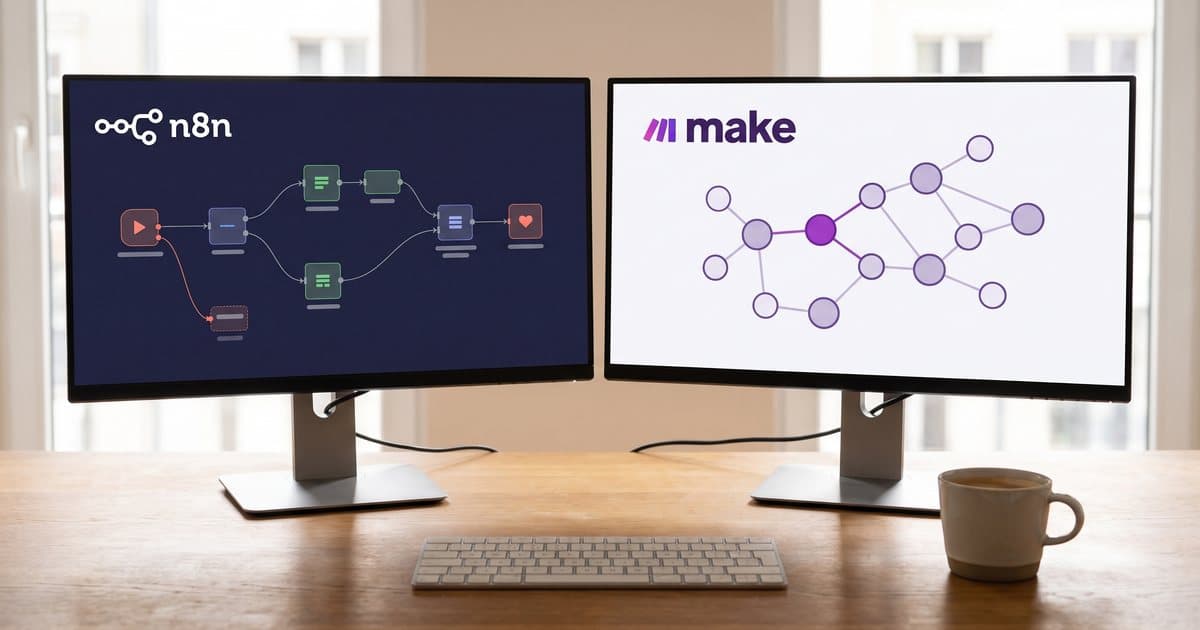
"n8n vs Make" is one of the questions I answer most often, both for clients and for other agency owners. I have used both, so this is a real comparison rather than a guess.
I run a small SEO and web agency, Glide Marketing. I use Make for one job today, I gave n8n a proper go on both Cloud and a self-hosted server, and I now build most of my automations directly with Claude Code. That mix is why I can be straight about where each tool earns its place. The honest answer to which one wins is "it depends", but by the end of this you will know exactly which fits your situation.
If you want to try the managed option as you read, you can start a free Make account here. n8n is at n8n.io.
The quick version
Make is a fully managed cloud tool. You sign up, build in the browser, and never think about servers. It bills by operations.
n8n is open source. You can pay for n8n Cloud and have it managed for you, or you can self-host it on your own server for tight cost control. That self-hosting option is the single biggest difference between the two.
n8n vs Make at a glance
| Factor | Make | n8n |
|---|---|---|
| Hosting | Managed cloud only | Cloud or self-hosted |
| Pricing model | Per operation | Cloud subscription, or server cost if self-hosted |
| Ease of first setup | Slightly friendlier | Slightly more technical |
| Self-hosting | Not possible | Yes, a core strength |
| Integrations out of the box | Larger library | Solid, plus strong custom HTTP and code |
| Data control | Held on Make's cloud | Full control when self-hosted |
| Best for | Speed and simplicity | Control and flat costs at scale |
| Open source | No | Yes |
Pricing model: operations vs a server
This is where the two really diverge.
Make charges by operations. One operation is one action by one module. Your plan gives you a monthly pool, and heavy scenarios burn through it faster than light ones. It is a fair model, and for most small businesses it works out reasonable. Billing is in US dollars.
n8n gives you two paths. n8n Cloud is a subscription, similar in spirit to Make. Self-hosted n8n is different: you pay for a server and then run as many workflows as that server can handle, no matter the volume. If you run a lot of high-volume automations, self-hosting can make the per-workflow cost almost disappear.
My real spend tells the story. n8n Cloud cost me around £28 a month. Self-hosting n8n was about £5 a month for the server, far cheaper on paper, but it ate my time. The one scenario I still run on Make costs around £6 a month. The pattern is that Make is easier to predict early on, and self-hosted n8n only wins once volume climbs and you have someone happy to run the server.
Ease of use
Both tools use a visual canvas where you connect nodes, and both take a few weeks to feel natural. Neither is a ten-minute, set-and-forget tool.
Make feels a touch more polished for someone who has never built an automation. The onboarding holds your hand a little more. If you want the detail on that, I wrote a full Make.com review.
n8n feels more at home if you are comfortable with data and a bit of logic. Developers often prefer it because it gets out of the way and lets them drop in custom code when they need to.
Self-hosting: the deciding factor for many
Make cannot be self-hosted. That is the whole sentence.
n8n can, and for some businesses that changes everything. Self-hosting gives you two things: flat, predictable costs regardless of volume, and full control over where your data sits. For a UK agency handling client data, data control can matter as much as price.
The trade-off is that self-hosting is a job. Someone has to set up the server, keep it updated and fix it if it breaks. I go deep on that decision in my n8n cloud vs self-hosted piece, because it is the choice that trips most people up.
Integrations
Make has the larger library of ready-made connectors. If you use a common UK business app, the odds are good there is a polished module waiting for you.
n8n has a strong and growing set, and it leans hard on custom HTTP requests and code nodes. That means a developer can connect almost anything, even a tool with no official node. For non-technical users, Make's bigger library is the safer bet; for technical teams, n8n's flexibility often wins.
When to pick which
Pick Make if you want to start fast, you do not want to manage a server, and you value a large library of ready-made connections. It is the one I point most non-technical small business owners to first. You can create a free Make account here.
Pick n8n if you want to self-host for flat costs or data control, you have someone comfortable with a little technical setup, or you expect high automation volume. Start at n8n.io.
Honestly, you can run both. Plenty of teams do, keeping simple high-volume jobs on self-hosted n8n and using Make for the connectors n8n does not have yet. I went a different way. I kept one job on Make and moved the rest to custom automations I build with Claude Code, because for my volume, running an n8n server was more upkeep than it saved me.
For a wider view of the software I rely on, see my best AI tools for UK entrepreneurs guide.
My verdict
There is no single winner, and anyone who tells you otherwise is selling something. Make wins on speed and simplicity. n8n wins on control and cost at scale. For most UK small businesses starting out, Make is the gentler first step, and n8n is there when you outgrow the managed model.
Mike McDonnell. I write The Growth Toolkit, a free Sunday email on getting the most out of AI, with the setups I use explained in plain English.

Mike McDonnell
Entrepreneur, author, and mental health advocate based in Great Notley, Braintree, Essex. I write about building businesses while managing bipolar disorder.
You might also like
Make.com Review UK: What My Real Automations Cost
An honest Make.com review from a UK agency owner. What Make is, how I use it at Glide Marketing, how the operations-based pricing really works, the pros, the cons, and my verdict.
n8n Cloud vs Self-Hosted for a Small Agency
A practical n8n Cloud vs self-hosted comparison for a small agency. Cost trade-offs, maintenance effort, data control, and when self-hosting is genuinely worth it.
I Built an AI Personal Trainer That Checks In on Me (2026)
I was an online PT for 2 years. Here's the AI personal trainer I built that checks in on Telegram every night and reviews my photos. Get the full setup free.